
Energy Oversight Briefing: Implementation of the Utility RELIEF Act and Other Issues
There is a lot of really informative information for energy related topics.
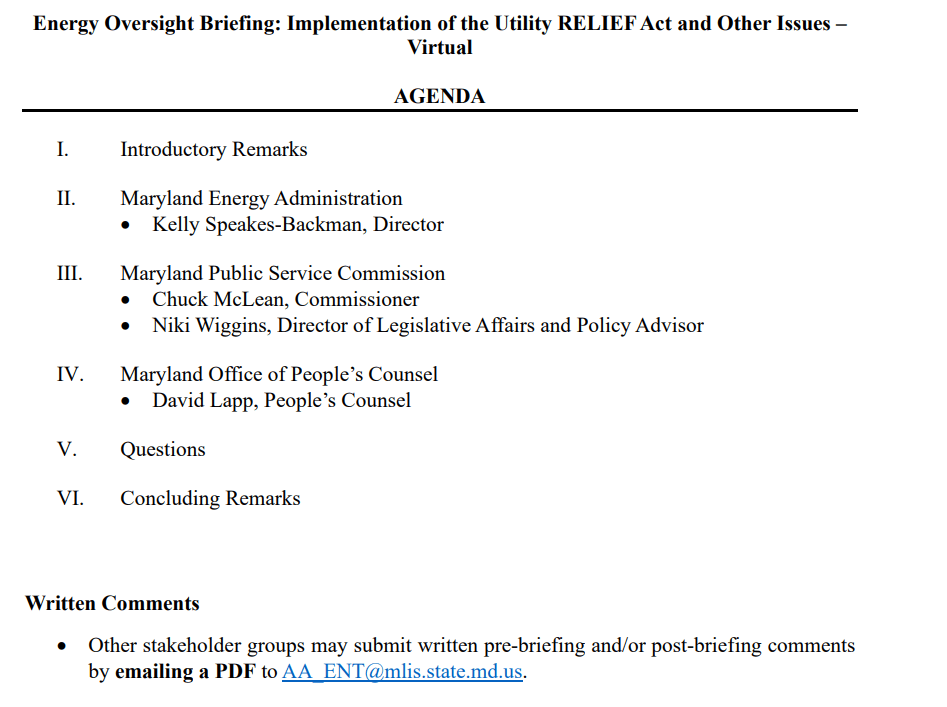

There is a lot of really informative information for energy related topics.
During 2026 Legislative Session, there are so many presentations, discussions and legislations related to energy, utility price, regulations. We are determined to fix the high utility cost issue facing our constitutes.
Hopefully the following presentations will help all to understand these issues better.
Three presentations from PSC, OPC and DNR. These are really informative.


Brittany Baker Maryland Director, Chesapeake Climate Action Network
There is so much information to help us understand the high energy cost issue. Please read it.
Below is a clear, regulator-accurate breakdown of which parts of your Washington Gas bill are avoidable vs. unavoidable, and what actions (if any) actually reduce each charge.
You pay these no matter what supplier you choose and even if gas prices fall.
~$34–36 of your $47.98 bill is unavoidable
No supplier switch, negotiation, or timing can remove these.
Can be reduced only by using less gas
These scale with usage:
How to reduce them:
⚠️ But note:
Even cutting usage 30% usually lowers the bill only ~15–20%.
These are the only charges you can change via supplier choice
📌 Most people save little or nothing long-term.
| Charge Type | Avoidable? | How |
|---|---|---|
| Distribution | ❌ No | None |
| STRIDE | ❌ No | None |
| System charge | ❌ No | None |
| EmPower MD | ❌ No | None |
| Taxes | ❌ No | None |
| Gas supply (PGC) | ✅ Yes | Switch supplier |
| All charges | ⚠️ Partially | Use less gas |
Washington Gas is essentially a fixed-cost utility disguised as a usage bill.
If you want next:
Just say the word.