2024 Newsmaker: Overcoming Asian American Invisibility

2024 Newsmaker: Overcoming Asian American Invisibility

Newsmaker: Overcoming Asian American Invisibility (nsba.org)

Our article focusing on “Overcoming Asian American Invisibility” was published on July 2024 American School Board Journal.

The impact, struggles, and contributions of Asian Americans to the nation have often been relegated to the margins. Changing narratives and including a representative version of Asian American history in our schools’ curricula is critical to reversing years of invisibility, write a group of education leaders and students.

July 08, 2024

Asian Americans have long been a part of this nation’s fabric. The presence of Asians in America has been recorded as early as the 1760s. However, our impact, stories, struggles, and contributions to the United States for three centuries have been relegated to the margins.

When asked, over half of Americans surveyed could not name a prominent Asian American public figure, according to a 2022 CNBC report. On the big screen, whether it be Hollywood, the sports field, or the news, Asian American faces are missing. Despite comprising 6.1% of the population, less than 2% of movies released in 2022 centered on Asian American stories; players of Asian American descent constitute less than 4% of any professional sports league; and Asian American members make up just 0.9% of elected leaders across all levels of government. Across 31 states totaling 7,386 legislative seats, there are just 152 Asian American state legislators, according to Axios.

When the public does not see Asian American faces in media and leadership positions, we are subjected to harmful characterizations such as the perpetual foreigner who lacks creativity and leadership. These stereotypes manifest into microaggressions that harm Asian American individuals and communities. These characterizations create barriers for Asian Americans to achieve economic mobility, inflict physiological harm on Asian Americans, and continue to perpetuate systemic inequality.

Discrimination and racist immigrant policy

To understand the origins of Asian American invisibility, an examination of U.S. history is necessary. The 1882 Chinese Exclusion Act is an example of the erasure of Chinese Americans: It was one of the first major and absolute bans on an ethnic group and lasted for more than 60 years. Chinese immigrants hoping to immigrate to the U.S. for work experienced additional restrictions, such as limited access to bail bonds and required identification certificates to avoid deportation. Though the Chinese Exclusion Act was finally repealed in 1943 with the Magnuson Act, which allowed for a quota of just 105 Chinese immigrants per year, its lasting impact continues to be felt by Chinese Americans. The act intensified discrimination against laborers and increased difficulty in obtaining citizenship. As such, Chinese Americans struggled to achieve positions in media and the government, setting the stage for the lack of representation we see today. 

The most visible example of racist policies is arguably Executive Order 9066, signed by President Franklin D. Roosevelt in 1942, which greenlit the internment of Japanese Americans during World War II. Over 100,000 Japanese Americans were forcibly relocated, incarcerated, and stripped of their civil liberties at the internment camps, where they experienced harsh living conditions.

These laws are only the tip of the iceberg in terms of how Asian Americans have been systematically discriminated against throughout U.S. history, attempting to erase the Asian American presence in this country.

Asian American visibility

Asian Americans are American. Multiple concurrent efforts are needed to combat invisibility. Members of the Asian American community must become more engaged in many fields of work and service to bring to light our experiences and contributions. Private and public collaboration with local Asian American groups is crucial to increase representation. Government, nonprofit, and media associations must intentionally promote the Asian American community.

Education is another crucial tool for improving Asian American visibility. Recent research conducted by Maryland Delegate Chao Wu’s interns, including Lily Peng, reported that in Maryland’s curricula, Asian Americans were mentioned in just 5% and 33% of content topics in middle and high school U.S. history frameworks, respectively.

The majority of these references place the Asian American community in the context of war and conflict, which brings attention to the struggles and hardships of the community but fails to celebrate its achievements and successes. Changing narratives and including a representative version of Asian American history in school curricula is critical to avoid a self-fulfilling prophecy where low discourse is a barrier to change.

The struggle for Asian American visibility is a continuous effort by community members to uproot deep, systemic issues. As of now, seven states — California, Colorado, Illinois, Nebraska, Nevada, New Jersey and Oregon — have enacted legislation requiring the inclusion of Asian American studies in their K-12 curriculum.

With action happening now to uplift Asian Americans and diversify narratives about the community, particularly through education curricula, there is hope for a nation where Asian Americans are seen.

Lily Peng and Emma Lu are students at River Hill High School, and Eileen Wu is a student at Clarksville Middle School, Howard County, Maryland. Judy Zhou (jz711@georgetown.edu) is a student in the Walsh School of Foreign Service, Georgetown University, Washington, D.C. Linfeng Chen (linfeng.chen@gmail.com) is a board member and Yun Lu (yun.lu@hcpss.org) is the vice chair of the Howard County Board of Education. Julie Yang (julie_yang@mcpsmd.org) is a member of the Montgomery County Board of Education, Maryland. Chao Wu (chao.wu@house.state.md.us) is a member of the Maryland House of Delegates District 9A and a former member of the Howard County Board of Education.

2023 Newsmaker: Asian American stories of resistance and joy

Newsmaker: Asian American stories of resistance and joy

Our new article on National School Board Association’s American School Board Journal.

https://nsba.org/ASBJ/2023/august/newsmaker-aapi-joy-and-resistance

July 11, 2023

Despite persisting discrimination, Asian Americans and Pacific Islanders are pushing for increased visibility of their communities and their heritage, both inside and outside of the classroom.

The American public school system is changing. As the epidemic of anti-Asian hate swelled to a new peak during the COVID-19 pandemic, activists have pushed back against harmful stereotypes. In school systems across the U.S., policymakers have advocated for changes to their state’s curriculum to reflect better the diversity of their student body and surrounding communities. Illinois, the first state to require the teaching of Asian American history in 2021, began implementing this new curriculum in public schools this academic year. In May, Florida became the most recent state to require Asian American history to be taught in its classrooms.

The progress made by Asian American activists, policymakers, and educators has been impressive, but the work is not finished. Anti-Asian hate and ignorance continue to pervade classrooms, despite these efforts. In May 2023, the Maryland state legislature passed a bill that provided grants to local school systems to encourage more student field trips to museums, such as Asian American and Pacific Islander (AAPI) museums. Yet, students continue to face discrimination, even with additional efforts to increase diversity. A first grader in Maryland’s Howard County Public School System was repeatedly harassed by her peers on the way home from school, where other students would make inappropriate gestures and make fun of her Chinese heritage. Moreover, required reading materials and a lack of nuanced discussions about U.S.-China foreign policy have increased anti-Chinese sentiments within classrooms. These sentiments are often directed at Chinese American students. Linfeng Chen, a Howard County school board member, recalled that his son felt ostracized when the school morning announcements replayed news reports about the “spy balloon.”

Other Chinese American students felt uncomfortable reading Red Scarf Girl in their middle school English classes because they felt that the book painted the Chinese government in a negative light and placed those stereotypes on all Chinese people. Nearly half of all Asian Americans and Pacific Islanders nationwide reported experiencing discrimination in 2023, and Asian American students are a part of that statistic. Even with the progress in incorporating Asian American history into school curricula, discrimination and anti-Asian hate still plague Asian American students. Our public school system must address this hatred and incorporate more inclusive, culturally competent changes to classrooms.

In the face of these challenges, the Asian American community in Howard County has pushed for the school system to recognize their culture and traditions. The Asian American communities rallied together for years to petition the school board to add Asian American holidays to the school calendar, which only included Christian and Jewish holidays. In 2016, the school board voted to expand its calendar to include Eid Al-Adha, Lunar New Year, and Diwali as days for school closure to allow Asian American students the opportunity to celebrate these holidays with their families at home.

Asian American students and parents have strived to share their holidays and cultural traditions with peers and school faculty, as well. Every year, around Lunar New Year, families visit their children’s schools and spend their day making dumplings for the school’s teachers and staff. They also bring paper lanterns and other red-colored decor to line the hallways. Just as the hallways are decorated each year around Halloween and Christmas, the Lunar New Year decorations brighten the hallways and make students excited about the holiday.

Asian American youth have used their agency as student leaders to create clubs and events that celebrate the diversity of cultures at their school. In Howard County, Project Lotus aims to share Asian American culture. Its members collaborated with other student clubs, such as the Black Leadership Union and the Muslim Student Association, to host a Culture Day to celebrate the diversity within the schools’ student body. Lily Peng, a high school student and the founder of Project Lotus, expressed that “the months of planning were all worth it to see the community come together and celebrate each other’s cultures.” The event boasted performances and cultural activities that attendees could participate in. Reflecting on the impact of that night, Lily believed that Culture Day “reaffirmed the importance of diverse communities” at her school. Asian American culture and traditions are a part of the diversity that make up our schools, communities, and country. Recognizing and including the Asian American community is not adding to the picture of America but completing it.

Despite persisting discrimination, Asian Americans have pushed for the visibility of their community and their heritage inside and outside of the classroom. The Asian American community is an intrinsic part of the fabric of the U.S. Asian Americans are students, leaders, mentors, volunteers, and community members in towns and cities across the nation. Our history, culture, and traditions deserve to be learned about and celebrated.

Judy Zhou (jz711@georgetown.edu) is a student at Georgetown University’s Walsh School of Foreign Service. Lily Peng and Julia Chen are 11th-grade students in the Howard County Public School System, Maryland. Linfeng Chen (linfeng.chen@gmail.com) is a member of the Howard County School Board. Yun Lu (yun.lu@hcpss.org) is vice chair of the Howard County School Board. Chao Wu (chao.wu@house.state.md.us) is a member of the Maryland House of Delegates, District 9A.

2023 article on American School Board Journal: Asian American stories of resistance and joy

2023 Newsmaker: Asian American stories of resistance and joy | Dr. Chao Wu

2022 article on American School Board Journal: The Inclusion of Asian American Studies in Schools Becomes a Reality

The Inclusion of Asian American Studies in Schools Becomes a Reality | Dr. Chao Wu

2021 article on American School Board Journal: AAPI History is American History

AAPI History is American History | Dr. Chao Wu

2022 The Inclusion of Asian American Studies in Schools Becomes a Reality

Our new article is published at June 2022 Issue of American School Board Journal, an affiliate of National School Board Association. The link is:

https://www.nsba.org/ASBJ/2022/june/asian-american-studies

2023 article on American School Board Journal: Asian American stories of resistance and joy

2023 Newsmaker: Asian American stories of resistance and joy | Dr. Chao Wu

2022 article on American School Board Journal: The Inclusion of Asian American Studies in Schools Becomes a Reality

The Inclusion of Asian American Studies in Schools Becomes a Reality | Dr. Chao Wu

2021 article on American School Board Journal: AAPI History is American History

AAPI History is American History | Dr. Chao Wu

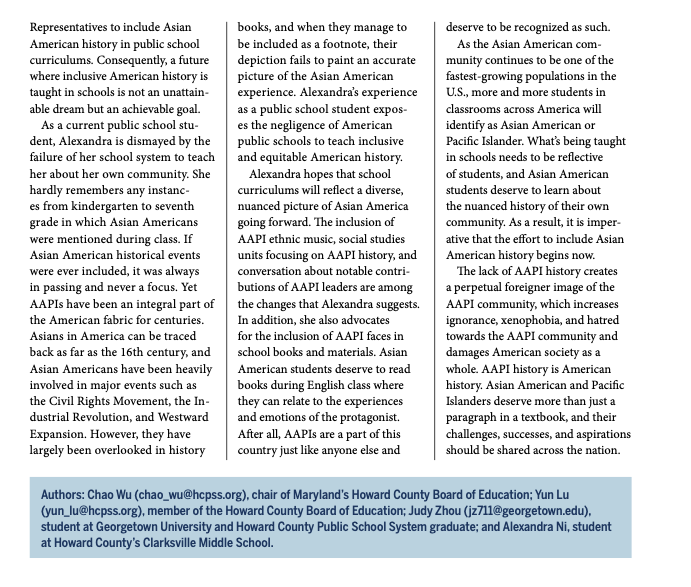
2021 newsmaker: AAPI History is American History

2021 newsmaker: AAPI History is American History

Our latest article (with Dr. Yun Lu, Ms. Judy Zhou and Ms. Alexandra Ni) is published on a national journal–American School Board Journal by National School Board Association.

2023 article on American School Board Journal: Asian American stories of resistance and joy

2023 Newsmaker: Asian American stories of resistance and joy | Dr. Chao Wu

2022 article on American School Board Journal: The Inclusion of Asian American Studies in Schools Becomes a Reality

The Inclusion of Asian American Studies in Schools Becomes a Reality | Dr. Chao Wu

2021 article on American School Board Journal: AAPI History is American History

AAPI History is American History | Dr. Chao Wu